See all articles

February 20, 2026
For many years, SEO meant picking a few keywords, ranking high, and waiting for clicks. This approach is no longer enough, as the way people search has changed. Today, users are not just browsing Google, they ask ChatGPT for recommendations, check Perplexity, read Google AI Overviews, and rely on AI assistants inside apps and platforms.
Just think about how you search today. You’re asking ChatGPT to compare products or expecting Google to give you a clear summary at the top of the page. So, it’s no longer just a few blue links, it’s basically a conversation. If your platform isn’t built to the right data to AI systems, you risk being overlooked in AI answers. A polished UI and clean code mean little if AI assistants cannot find, understand, and recommend your listings.
If you’re managing a digital product with a lot of traffic, you must be “answerable”. This is where AI Optimization (AIO) can help you. And just to be clear, AIO is not a replacement for traditional SEO. It upgrades your product needs in order to stand out in today’s market.
Recent studies show that around 60 percent of searches end without a click because AI tools provide direct answers. This means users often get information without visiting a website. If AI doesn’t understand your product, your brand simply disappears from the conversation. As you can see, now you have two audiences: humans and machines.
At this point, you might be asking yourself: how do I make my product show up in AI-generated answers and Google AI Overviews? The answer starts with how your data is structured and delivered.
To build a successful product today, you need to understand two distinct ways people find your content: traditional search engines and AI assistants.
SEO (Search Engine Optimization) is the classic way to get noticed. It focuses on how search engines like Google discover, crawl, and rank your pages. In practice, that means solid technical foundations, clear site structure, relevant content, and credible links from other sites. Your goal here is to prove to Google that your website is the most relevant link for a specific term, like "used electric cars." When you do SEO right, you get a high spot on the results page, and a human clicks your link to visit your site.
AIO (Artificial Intelligence Optimization) is the new layer on top of SEO and it’s about being understood. It doesn’t replace SEO. AIO focuses on how AI systems read, interpret, and reuse your information. That includes how well your data is structured, how clearly your content is written, and how consistently you use key terms. When a user asks an AI assistant, "Which used SUV has the best safety rating for a family of four?," the AI doesn't just list websites. It analyzes information from across the web and delivers a direct answer. If your product is optimized for AIO, the AI will use your data to build that answer and cite you as the trusted source.
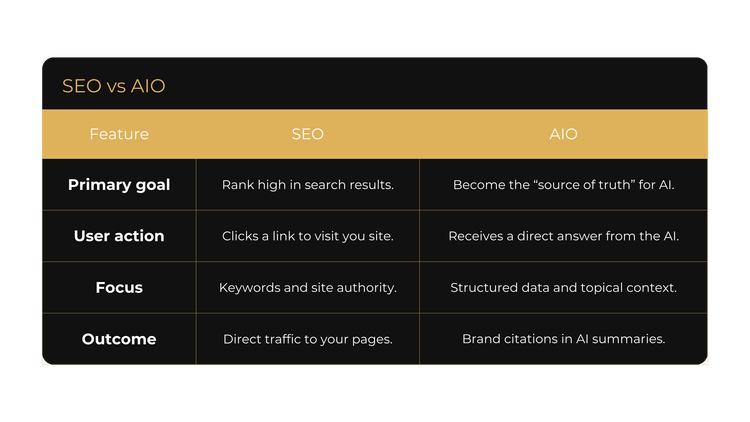
The main difference lies in how information reaches the user.
→ SEO brings people to your page so they can find the answer themselves. → AIO delivers the answer directly through an AI assistant that speaks on your behalf.
You cannot choose one over the other anymore. If you only do SEO, you miss out on the millions of people using AI chat for their research. If you only do AIO, you might lose the direct traffic that traditional search still provides. Modern growth requires a balance of both.
Let’s make this practical. We will use a used car marketplace as our example, because it shows clearly how SEO and AIO work together in a real product. If you already run or plan on building a marketplace like this, here’s how SEO and AIO should work, step by step:
Before exploring the latest AI trends, you should focus on the basics. Google has used web crawlers for decades to scan your site. AI models like ChatGPT or Google’s Gemini do the same. AI won’t ever find you if your SEO isn’t working properly.
This means your marketplace needs a clear, logical structure. You need clean URLs, a mobile experience that loads quickly, and a sitemap that actually works. Start by speeding up your website, fixing your meta tags, and making sure that every page is easy for a robot to find. When you build a strong SEO foundation, you are building a map that AI assistants will use to navigate your inventory.
Before moving on to AIO, make sure your platform already supports the following:
Treat structured data as part of your core product design. When designing a digital product, it’s important to consider not just what information is shown to users, but how that information is interpreted by search engines and AI systems.
For instance, when humans look at the car listing page they understand it instantly. Google and AI systems can’t do that as easily without clear guidance. They rely on structured signals that explain what each piece of information represents.
To ensure your listings are correctly understood, the dev team should implement structured data using the most widely used standard for this - schema.org. This is typically done through JSON-LD, a machine-readable format added to each listing page. While users do not see this layer, it allows AI tools to clearly identify:
Many users now get answers directly from AI or Google summaries. They ask a question and expect an answer without ever clicking a link. These are zero-click searches.
Think about the types of questions someone asks when buying a used car:
If your pages do not provide clear answers, AI systems will extract information from another source instead. To solve this, design your key pages to include short, direct responses to these common questions.
This approach helps users make faster decisions. It also gives search engines and AI systems content they can extract and present as a direct answer. When someone asks, “Is this used SUV good for a family of four,” the system can use your explanation instead of pulling information from another source.
Even if the user never clicks, your marketplace becomes the source behind the answer.
Today, when someone searches for a used car, they are not just looking for options. They’re looking for something they can trust.
If your marketplace shows listings with little context, unclear sellers, or no supporting information, it becomes difficult for machines to determine whether your content is reliable.
E-E-A-T stands for Experience, Expertise, Authoritativeness, and Trustworthiness. It’s one of the key frameworks search engines use to evaluate the credibility of a website and its content.
However, AI systems do not evaluate trust based on content alone. They also evaluate the quality and consistency of the underlying data behind your listings. This is where data authority comes in. It refers to how clearly your product explains where its data comes from, how it is verified, and how consistently it is presented across the platform.
For example:
If these questions are left unanswered, both users and AI systems may hesitate to rely on your platform. Trusted sources are far more likely to be ranked and cited.
Many marketplaces rely on their search functionality only. The problem is that search engines and AI systems can’t interact with the search filters the same way a user can.
If the only way to find cars on your platform is by manually selecting brand, model, fuel type, and price range, much of your inventory stays hidden from search engines. In practice, this means thousands of relevant vehicles exist on your marketplace, but only a small portion of them are discoverable through search or AI answers.
To solve this, the development team should implement programmatic SEO. They would create dedicated structured pages based on your inventory, such as brand pages like “Used BMW cars”, model pages like “Used BMW X5”, or intent-based pages like “Fuel-efficient city cars” or “Family SUVs”.
Each of these pages is enriched with structured information that explains what is being offered, who it is for, and what makes it relevant. This allows both search engines and AI systems to understand and recommend your inventory in response to user questions.
A common mistake in digital products is treating user experience as a visual concern only. Slow pages, inconsistent listing layouts, missing image descriptions, and confusing navigation don’t just frustrate buyers, they also make it harder for search engines and AI systems to interpret your content correctly.
To address this, the development team should standardize how listings are presented across the platform, optimize page speed, ensure mobile-friendly browsing, and add descriptive alt text to visual content.
Fast, consistent, and easy-to-navigate pages improve rankings and increase the chances that AI systems will reference your content.
Sold listings that lead to 404 pages, broken internal links, or removed categories do more than disrupt user experience. They create gaps in your product’s information structure that search engines and AI systems rely on to understand how your inventory connects.
When an AI assistant encounters missing or inaccessible pages, it may lose the context needed to relate one product to another. This makes it harder to compare listings, recommend alternatives, or reference your marketplace as a reliable source.
To address this, the development team should redirect sold or removed listings to similar available vehicles, fix broken internal links, and ensure that all important pages remain accessible through logical navigation.
This preserves the relationships between your products, improves crawlability, and increases the chances that AI systems will reference your marketplace when generating recommendations.
Many product owners still measure success using traditional SEO metrics alone. Rankings, impressions, and clicks are important, but they no longer show the full picture. Today, if you only track traffic, you may miss where your visibility is actually growing. To get a more accurate view of performance, you should measure success across both traditional search and AI-driven discovery. This includes:
Monitoring keyword rankings and organic impressions Use tools like Google Search Console or SEO platforms such as Ahrefs or Semrush to track how your pages perform in traditional search.
Tracking referral traffic from AI-powered assistants where possible Analytics platforms like Google Analytics can help you identify incoming traffic from sources such as Perplexity or ChatGPT when referral data is available.
Observing whether AI-generated answers reference your product Run regular prompt audits by asking AI assistants questions your users would typically search for and note whether your content is mentioned or cited in the response.
This helps you understand not just who visits your site, but also where your content is being used as a trusted source.
The tools you use to build your product determine how well it performs in an AI world. You can have the best data in the world, but if your technology stack hides it, AI agents will move on to the next source.
At Ncoded solutions, we prioritize frameworks that support server-side rendering (SSR) or static site generation (SSG), such as Next.js. This is a critical technical choice. Traditional websites often rely on the user's browser to load content, which shows a "loading spinner" while the data fetches. AI crawlers do not like to wait. By using SSR, we ensure that the moment a crawler or a chatbot hits your page, it sees the full data immediately.
We also build using an API-first and headless architecture. This separates your data layer from the presentation layer and allows the same structured information to power your user interface while remaining accessible through machine-readable endpoints.
To improve performance further, we use edge computing and CDN distribution. Content is served from locations closer to the user or crawler, which reduces latency and improves load times.
Beyond speed, your stack must handle dynamic updates. In many digital products, inventory or pricing changes frequently. We implement real-time indexing using webhooks to notify search engines and indexing systems immediately when updates occur. If your system delays these updates, outdated information may appear in search results or AI-generated answers, which can affect both credibility and conversions.
When your product is built on a stack that supports visibility by design, both search engines and AI systems can access, understand, and reuse your content more effectively.
You can easily check if your application is prepared for the current search landscape.Give yourself 1 point for every “yes.”
0–4 points: Your SEO setup is outdated for AI-driven search. AI assistants are unlikely to interpret or reuse your content reliably.
5–7 points: You have a solid foundation, but your product may still be difficult for AI systems to understand or cite.
8–10 points: Your product is aligned with modern search. Both search engines and AI assistants can understand, trust, and reuse your content.
You may also like

You need to find a dedicated software team? Here’s how to do it #16
Learn how to choose the right dedicated development team that fits your product, your goals, and your way of working.
July 10, 2025tips-and-tricks

Agile and Scrum in Ncoded Solutions #6
Project management strategies
February 07, 2024tips-and-tricks